
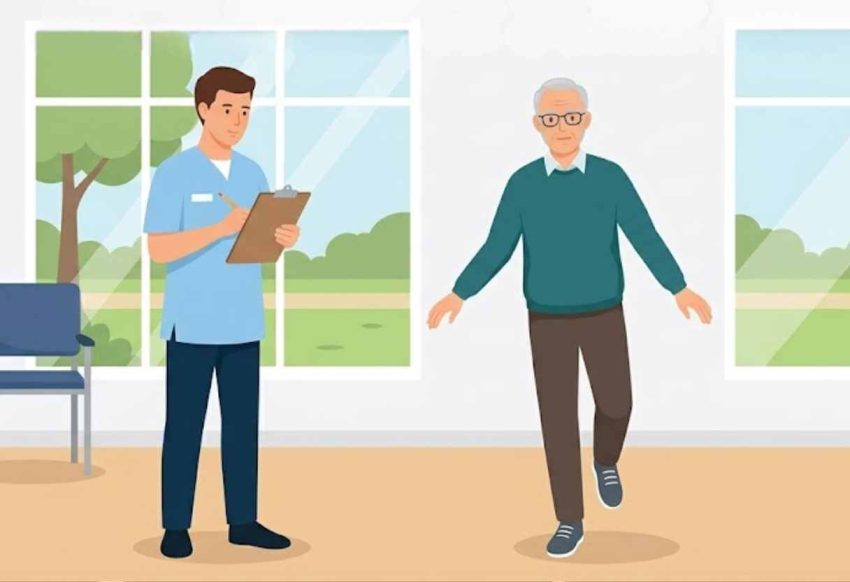
Quick answer: Score each of the 14 Berg Balance Scale tasks from 0 to 4 using the standardised criteria below, then sum all items for a total out of 56. A score below 45 indicates elevated fall risk. Use our free Berg Balance Scale calculator to score and document results automatically.
But accurate scoring requires more than knowing the total. This guide covers every task instruction word-for-word, the exact criteria for each score point, the most common scoring errors that PTs make, and how to correctly interpret and document the result for your EMR.
What Is the Berg Balance Scale?
The Berg Balance Scale (BBS) is a 14-item standardised clinical assessment developed by Katherine Berg, PT, PhD in 1989 to evaluate static and dynamic balance function in older adults and patients with balance impairments. It is one of the most widely used and thoroughly validated outcome measures in physical therapy, with excellent inter-rater reliability (ICC = 0.95–0.98) and strong predictive validity for fall risk.
The BBS is appropriate for use across a broad range of clinical populations including community-dwelling older adults, post-stroke patients, those with Parkinson’s disease, multiple sclerosis, vestibular dysfunction, lower extremity amputees, and patients in acute and subacute rehabilitation settings.
Equipment You Need
- Two chairs — one with armrests, one without (or a plinth/bed)
- A step or footstool (approximately 20 cm / 8 inches high)
- A stopwatch
- A ruler or tape measure
- One small object to place on the floor (shoe, block, or similar)
- Approximately 5 metres / 15 feet of clear floor space
Time to Administer
15–20 minutes for the full 14-task assessment. Each item is performed once unless the instruction is unclear to the patient, in which case one repeat is permitted.
General Scoring Rules Before You Begin
Before going task by task, understand these core rules — they govern how every item is scored:
- Always read the standardised instruction aloud for each item. Do not paraphrase. Patient comprehension differences will affect scores if instructions vary between assessors.
- Score what you see, not what you assist. If you touch the patient to prevent a fall, the score for that item reflects the lowest relevant criterion — not what they would have achieved unassisted.
- Safety first. Stand close to the patient throughout but do not touch or assist unless a fall is imminent.
- Score 0 if the patient requires maximum assistance or cannot attempt the task.
- Time-based items require a stopwatch. Do not estimate.
- Footwear: patient should wear their usual footwear. Do not ask them to remove shoes.
All 14 Berg Balance Scale Tasks — Scored Step by Step
Item 1: Sitting to Standing
Instruction to patient: “Please stand up. Try not to use your hands for support.”
| Score | Criteria |
|---|---|
| 4 | Able to stand without using hands, independently and safely |
| 3 | Able to stand independently using hands |
| 2 | Able to stand using hands after several attempts |
| 1 | Needs minimal assist to stand or stabilise |
| 0 | Needs moderate or maximal assist to stand |
Common error: Scoring 3 when the patient uses armrests for one brief push — this still warrants a 3, not a 4. Only award 4 if the patient rises without any upper extremity support.
Item 2: Standing Unsupported
Instruction: “Please stand for two minutes without holding on.”
| Score | Criteria |
|---|---|
| 4 | Able to stand safely for 2 minutes |
| 3 | Able to stand for 2 minutes with supervision |
| 2 | Able to stand for 30 seconds unsupported |
| 1 | Needs several tries; can stand for 15 seconds unsupported |
| 0 | Unable to stand for 10 seconds without support |
Clinical note: If the patient achieves a score of 4 on this item, record full marks for Item 3 (sitting unsupported) without testing it — the ability to stand unsupported for 2 minutes implies adequate sitting balance.
Item 3: Sitting Unsupported With Feet on the Floor
Instruction: “Please sit with your arms folded for two minutes.”
| Score | Criteria |
|---|---|
| 4 | Able to sit safely and securely for 2 minutes |
| 3 | Able to sit for 2 minutes under supervision |
| 2 | Able to sit for 30 seconds |
| 1 | Able to sit for 10 seconds |
| 0 | Unable to sit without support for 10 seconds |
Item 4: Standing to Sitting
Instruction: “Please sit down.”
| Score | Criteria |
|---|---|
| 4 | Sits safely with minimal use of hands |
| 3 | Controls descent using hands |
| 2 | Uses back of legs against chair to control descent |
| 1 | Sits independently but has uncontrolled descent |
| 0 | Needs assistance to sit |
Common error: Confusing a controlled hand-assisted descent (score 3) with an uncontrolled drop (score 1). Watch closely throughout the full descent.
Item 5: Transfers
Instruction: “Arrange the chair(s) for a pivot transfer. Ask the patient to transfer one way toward a seat with armrests and one way toward a seat without armrests.”
| Score | Criteria |
|---|---|
| 4 | Able to transfer safely with minor use of hands |
| 3 | Able to transfer safely but definitively needs hands |
| 2 | Able to transfer with verbal cueing and/or supervision |
| 1 | Needs one person to assist |
| 0 | Needs two people to assist or supervise for safety |
Item 6: Standing Unsupported With Eyes Closed
Instruction: “Please close your eyes and stand still for ten seconds.”
| Score | Criteria |
|---|---|
| 4 | Able to stand for 10 seconds safely |
| 3 | Able to stand for 10 seconds with supervision |
| 2 | Able to stand for 3 seconds |
| 1 | Unable to keep eyes closed for 3 seconds but stands safely |
| 0 | Needs help to avoid falling |
Item 7: Standing Unsupported With Feet Together
Instruction: “Place your feet together and stand without holding on.”
| Score | Criteria |
|---|---|
| 4 | Able to place feet together independently and stand for 1 minute safely |
| 3 | Able to place feet together independently and stand for 1 minute with supervision |
| 2 | Able to place feet together independently but unable to hold for 30 seconds |
| 1 | Needs help to attain position but can stand for 15 seconds |
| 0 | Needs help to attain position and unable to hold for 15 seconds |
Item 8: Reaching Forward With Outstretched Arms
Instruction: “Lift your arm to 90 degrees. Stretch out your fingers and reach forward as far as you can.” (Measure distance reached — use a ruler or tape on a wall.)
| Score | Criteria |
|---|---|
| 4 | Can reach forward confidently >25 cm (10 inches) |
| 3 | Can reach forward >12.5 cm (5 inches) safely |
| 2 | Can reach forward >5 cm (2 inches) safely |
| 1 | Reaches forward but needs supervision |
| 0 | Loses balance while trying, requires external support |
How to measure: Mark the position of the fingertips at rest and at maximum reach on a fixed surface. Measure the difference. This is a functional reach test embedded within the BBS.
Item 9: Picking Up an Object From the Floor
Instruction: “Pick up the shoe/slipper which is placed in front of your feet.”
| Score | Criteria |
|---|---|
| 4 | Able to pick up slipper safely and easily |
| 3 | Able to pick up slipper but needs supervision |
| 2 | Unable to pick up but reaches 2–5 cm (1–2 inches) from slipper; maintains balance independently |
| 1 | Unable to pick up; needs supervision while trying |
| 0 | Unable to try or needs assistance to avoid losing balance or falling |
Item 10: Turning to Look Behind Over Shoulders
Instruction: “Turn to look directly behind you over your left shoulder. Now repeat to the right.”
| Score | Criteria |
|---|---|
| 4 | Looks behind from both sides; weight shifts well |
| 3 | Looks behind one side only; other side shows less weight shift |
| 2 | Turns sideways only but maintains balance |
| 1 | Needs supervision when turning |
| 0 | Needs assist to keep from losing balance or falling |
Item 11: Turn 360 Degrees
Instruction: “Turn completely around in a full circle. Pause. Then turn a full circle in the other direction.”
| Score | Criteria |
|---|---|
| 4 | Able to turn 360° safely in ≤4 seconds each direction |
| 3 | Able to turn 360° safely one side only in ≤4 seconds |
| 2 | Able to turn 360° safely but slowly (>4 seconds) |
| 1 | Needs close supervision or verbal cueing |
| 0 | Needs assistance while turning |
Common error: Many clinicians forget to time this item. Use your stopwatch — the 4-second cut-off is clinically significant.
Item 12: Placing Alternate Feet on Step
Instruction: “Place each foot alternately on the step/stool. Continue until each foot has touched the step four times.”
| Score | Criteria |
|---|---|
| 4 | Able to stand independently and safely; completes 8 steps in ≤20 seconds |
| 3 | Able to stand independently; completes 8 steps in >20 seconds |
| 2 | Able to complete 4 steps without aid with supervision |
| 1 | Able to complete >2 steps; needs minimal assist |
| 0 | Needs assistance to keep from falling; unable to try |
Note: The step height should be approximately 20 cm / 8 inches — standard stair step height. A low step will artificially inflate the score.
Item 13: Standing Unsupported With One Foot in Front
Instruction: “Place one foot directly in front of the other. If you feel that you cannot place your foot directly in front, try to step far enough ahead that the heel of your forward foot is ahead of the toes of the other foot.”
| Score | Criteria |
|---|---|
| 4 | Able to place foot tandem independently and hold for 30 seconds |
| 3 | Able to place foot ahead of other independently and hold for 30 seconds |
| 2 | Able to take small step independently and hold for 30 seconds |
| 1 | Needs help to step but can hold for 15 seconds |
| 0 | Loses balance while stepping or standing |
Key distinction: Score 4 requires true tandem stance (heel directly touching toe). Score 3 is semi-tandem — heel ahead of toes but not touching. This distinction is frequently confused.
Item 14: Standing on One Leg
Instruction: “Stand on one leg as long as you can without holding on.”
| Score | Criteria |
|---|---|
| 4 | Able to lift leg independently and hold >10 seconds |
| 3 | Able to lift leg independently and hold 5–10 seconds |
| 2 | Able to lift leg independently and hold ≥3 seconds |
| 1 | Tries to lift leg; unable to hold 3 seconds but remains standing independently |
| 0 | Unable to try or needs assist to prevent fall |
This is the hardest item on the BBS and the most sensitive to genuine balance impairment. Even a score of 1 or 2 is clinically meaningful. Do not skip this item due to perceived safety risk — simply stand close to the patient.
How to Calculate the Berg Balance Scale Score
Add all 14 item scores together. The maximum possible score is 56 points. There is no reverse scoring — higher scores always indicate better balance function.
Use our free Berg Balance Scale calculator to automatically compute the total, generate a fall risk classification, compare to age-specific normative data, and produce an EMR-ready SOAP note entry in seconds.
Berg Balance Scale Score Interpretation
Primary Fall Risk Cut-offs
| Score Range | Interpretation | Functional Level |
|---|---|---|
| 41–56 | Low fall risk | Independent ambulation; no assistive device typically needed |
| 21–40 | Medium fall risk | Walking with assistance; assistive device likely required |
| 0–20 | High fall risk | Wheelchair-dependent; maximal assistance required |
The Critical Cut-off: Score of 45
The most widely cited clinical threshold is a score of 45 or below, which indicates a significantly elevated risk of falls (Shumway-Cook et al., 1997; sensitivity 91%, specificity 82%). This cut-off guides decisions around assistive device prescription, supervision levels, and discharge planning.
Additional thresholds supported by evidence:
- Score ≤36: fall risk approaches 100% in community-dwelling older adults
- Score ≤50: 59% fall risk in the next 6 months
- Score ≥49: indicates ability to walk without an assistive device
- Score ≥43: indicates ability to walk without a four-wheeled walker
Age-Stratified Normative Data
| Age Group | Mean BBS Score | Reference |
|---|---|---|
| 60–69 years | 53.7 ± 3.4 | Downs et al., 2014 |
| 70–79 years | 50.4 ± 5.8 | Downs et al., 2014 |
| 80–89 years | 44.1 ± 9.7 | Downs et al., 2014 |
| 90+ years | 34.2 ± 12.4 | Downs et al., 2014 |
Clinical application: A 75-year-old scoring 40 is below the mean for their age group (50.4) and below the 45-point fall risk threshold — indicating a clinically meaningful balance deficit requiring intervention. Simply knowing the score without context misses this.
MCID — What Score Change Is Clinically Meaningful?
The Minimal Detectable Change (MDC95%) for the Berg Balance Scale is 6.5 points — meaning a change of at least 6.5 points between two assessments is needed to be 95% confident that genuine improvement (not measurement error) has occurred (Stevenson, 2001; PubMed: 21937903).
Score-range-specific MDC values (Donoghue & Stokes, 2009):
- Initial score 45–56: MDC = 4 points
- Initial score 35–44: MDC = 5 points
- Initial score 25–34: MDC = 7 points
- Initial score 0–24: MDC = 5 points
Why this matters in practice: If your patient improves from 38 to 41 between sessions, that is a 3-point gain — below the MDC for their score range. You cannot confidently claim that represents a true functional improvement. Document this distinction in your SOAP notes to demonstrate evidence-based clinical reasoning.
Common Scoring Errors to Avoid
- Not timing Items 2, 6, 7, 11, 12, 13, 14. Each of these has a time-based criterion. Estimating without a stopwatch produces unreliable scores.
- Awarding score 4 when the patient used their hands. Item 1 score 4 specifically requires standing without hand use.
- Confusing tandem and semi-tandem stance on Item 13. Tandem = heel touching toe = score 4. Heel ahead of toes but not touching = score 3.
- Skipping Item 3 when Item 2 scores 4. This is the correct protocol — but make sure you understand why and document it.
- Not measuring the reach distance on Item 8. Estimating “about 10 inches” is not acceptable. Use a ruler and measure the difference between start and end position of the fingertips.
- Allowing the patient to wear different footwear than usual. The score should reflect their typical functional presentation.
Use the Free Berg Balance Scale Calculator
Rather than manually adding up scores and cross-referencing interpretation tables during a busy clinic session, use our free Berg Balance Scale calculator at MedicalCalculatorHub.com. It:
- Scores all 14 items interactively
- Automatically classifies fall risk using Shumway-Cook cut-offs
- Compares result to age-specific normative data
- Displays the MCID threshold for your patient’s score range
- Generates an EMR-ready SOAP documentation block
- Works on any device — phone, tablet, desktop — with no login required
→ Open the free Berg Balance Scale Calculator
BBS vs Other Balance Assessments — When to Use Which
| Assessment | Best For | Limitation |
|---|---|---|
| Berg Balance Scale | Older adults, post-stroke, general rehabilitation baseline | Ceiling effect in high-functioning patients; no gait assessment |
| Timed Up and Go (TUG) | Quick screening; includes gait component | Less granular than BBS; not item-level |
| Tinetti Balance Assessment | Nursing home residents; includes gait sub-score | Less studied than BBS; older normative data |
| BESTest / MiniBESTest | Higher-functioning patients where BBS has ceiling effect (e.g. post-TKA after 2 weeks) | Longer to administer |
| Dynamic Gait Index | Vestibular patients; gait-focused | Not a pure balance measure |
Key clinical decision: After total knee arthroplasty beyond 2 weeks post-surgery, the BBS has a known ceiling effect and poor sensitivity to change. Switch to the MiniBESTest for post-TKA patients at this stage.
SOAP Note Documentation — How to Write It Correctly
A complete BBS documentation entry should include:
- The total score and date
- The fall risk classification
- Comparison to age-specific normative mean
- Items with the lowest scores and their clinical significance
- The MCID threshold relevant to this patient’s score range
- Functional implications and plan
Example SOAP entry:
Berg Balance Scale administered per standardised protocol. Score: 38/56 (date: 25 May 2026). Classification: Medium fall risk (score 21–40). Below age-specific normative mean of 50.4 ± 5.8 for 70–79 year age group (Downs et al., 2014). Lowest scoring items: Item 14 (Standing on one leg, score 1) and Item 13 (Tandem stance, score 2), indicating significant impairment in unilateral weight-bearing and narrow base of support balance. MDC95% for this score range (35–44): 5 points — a minimum 5-point improvement is required to demonstrate clinically meaningful change. Plan: targeted balance training emphasising unilateral stance progression and dynamic weight-shifting. Reassess in 4 weeks.
Frequently Asked Questions
How long does it take to administer the Berg Balance Scale?
The full 14-item assessment takes 15–20 minutes for most patients. Allow additional time for patient instruction and positioning between items. Experienced clinicians familiar with the protocol may complete it in 12–15 minutes.
Can I administer the Berg Balance Scale without formal training?
The BBS requires minimal formal training compared to many outcome measures — the standardised instructions are built into the scale itself. However, you should be familiar with the scoring criteria for all 14 items before administering it clinically, and inter-rater reliability is highest among clinicians who have reviewed the protocol thoroughly. This guide provides that foundation.
What is the maximum Berg Balance Scale score?
56 points (14 items × 4 points each). A score of 56 indicates excellent functional balance. Most healthy community-dwelling adults under 70 score between 52 and 56.
At what score does fall risk become significant?
A score below 45 is the most widely used clinical threshold for elevated fall risk (Shumway-Cook et al., 1997). Below 36, fall risk in community-dwelling older adults approaches 100%.
Is the Berg Balance Scale valid for post-stroke patients?
Yes. The BBS has strong validity and responsiveness in post-stroke populations, with excellent inter-rater reliability (ICC = 0.95) at 14 days post-stroke (Berg et al., 1995). However, for very acute stroke (under 14 days) the Postural Assessment Scale for Stroke Patients (PASS) may be more appropriate due to floor effects of the BBS in severely affected patients.
What is the MCID for the Berg Balance Scale?
The MDC95% (Minimal Detectable Change at 95% confidence) is 6.5 points overall (Stevenson, 2001). Score-range-specific values range from 4–7 points. A change must exceed these thresholds to be considered a genuine functional improvement rather than measurement error.
Can the Berg Balance Scale be used for Parkinson’s disease patients?
Yes, with some limitations. The BBS is valid and commonly used in Parkinson’s disease, but ceiling effects can occur in early-stage PD patients who score above 50. The MiniBESTest may provide better discrimination at higher function levels in this population.
References
- Berg KO, Wood-Dauphinee SL, Williams JI, Maki B. Measuring balance in the elderly: validation of an instrument. Can J Public Health. 1992;83 Suppl 2:S7-11. PMID: 1468055.
- Berg KO, Wood-Dauphinee SL, Williams JI, Gayton D. Measuring balance in the elderly: preliminary development of an instrument. Physiother Can. 1989;41(6):304-311.
- Shumway-Cook A, Baldwin M, Polissar NL, Gruber W. Predicting the probability for falls in community-dwelling older adults. Phys Ther. 1997;77(8):812-819. PMID: 9256869.
- Stevenson TJ. Detecting change in patients with stroke using the Berg Balance Scale. Aust J Physiother. 2001;47(1):29-38. PMID: 21937903.
- Downs S, Marquez J, Chiarelli P. Normative scores on the Berg Balance Scale decline after age 70 years in healthy community-dwelling people: a systematic review. J Physiother. 2014;60(2):85-89. PMID: 24952835.
- Miranda-Cantellops N, Tiu TK. Berg Balance Testing. In: StatPearls. Treasure Island (FL): StatPearls Publishing; 2025. PMID: 33760508.
- Joa KL. Outcome Measurement in Balance Problems: Berg Balance Scale. Ann Rehabil Med. 2024;48(2):103-104. PMID: 38649325.
Written by Nikhil Mahajan, PT, MPT | Last reviewed: May 2026 | Free Berg Balance Scale Calculator →